Where Does Your B2B Sales Funnel Lose Buyers?
A sales team sees plenty of names at the top of its dashboard but few signed customers at the bottom. Marketing wants more inquiries. Sales wants better ones. Both requests might be reasonable, yet neither tells the team where buyers stopped making progress. If half the inquiries never describe a problem the company solves, more inquiries will add work. If qualified buyers reach a trial and then cannot get colleagues to use the product, a better lead source will leave the difficult part untouched.
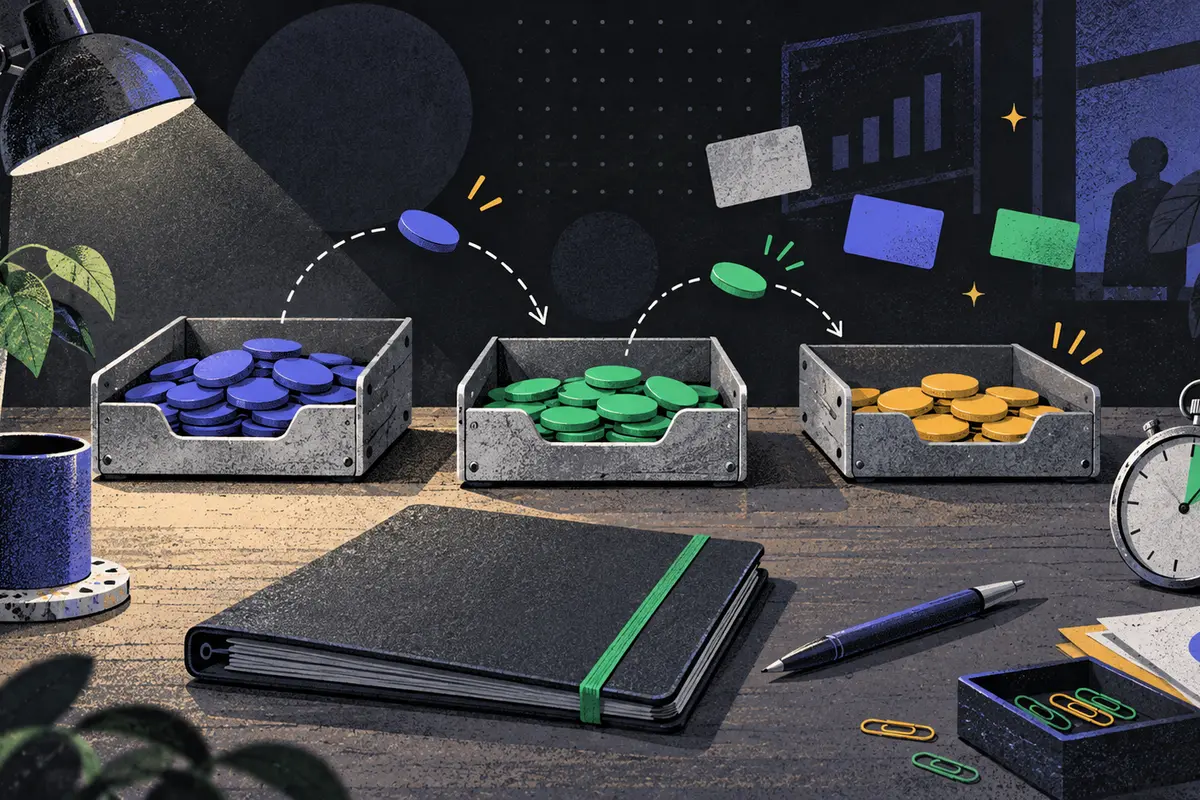
A B2B sales funnel makes that question specific. It shows how a defined set of businesses moves between observable steps in a purchase, from an initial expression of interest to a commercial decision. Salesforce describes the broader journey from awareness to purchase, while cautioning that buyers may revisit or skip steps; its stage criteria should reflect how the business actually sells. Salesforce’s sales funnel guide is a useful starting point, but the useful funnel is the one whose stages describe your buyers’ decisions.
The first choice is what to count. An email address, a person, a company, and an opportunity are different units. One company can have several interested employees and one purchase decision. Count five employees as five leads, then count their company as one deal, and the apparent drop between the two says little about sales performance. For a business sale, I would usually use an account or a clearly defined opportunity as the unit, then keep individual contacts attached to it. The exception is a product that each person can buy independently; in that case, a user-level funnel may answer the question more honestly.
A useful stage records what the buyer has done
Stage names such as awareness, consideration, and purchase explain the broad idea, but they do not tell a rep when to move a record. The practical question is whether another person looking at the same account would reach the same conclusion. “Interested” is too elastic. “Requested a demonstration” is observable. “Qualified” needs a local meaning: perhaps the buyer described a problem the product can address, identified the business unit affected, and agreed to a next conversation. Those criteria are decisions for the selling team, not universal definitions.
This matters because a funnel is a report on movement, not a script that forces every buyer into the same order. A buyer might ask for pricing before a demonstration. A team using a trial might evaluate the product before speaking with sales. Salesforce explicitly notes that prospects can move back and forth or skip stages. Its guide to stages and buyer behavior supports treating the model as a guide to real activity rather than a mandatory sequence. Record the route a buyer took instead of inventing an earlier meeting to make the chart look orderly.
Keep the distinction between a buyer’s state and a seller’s task. “Proposal sent” records work by the seller; “buyer accepted the proposed scope and began internal approval” records a changed buying position. The first can still be useful as a task milestone, but it should not automatically count as progress toward a purchase. If a team sends proposals before buyers agree on the problem, proposal volume may rise while buying commitment stays flat. The funnel should make that visible.
There is also a boundary between a funnel and a pipeline. A pipeline helps the seller manage open work: who owns the next call, which proposal is due, and which opportunities may close. A funnel groups the movement of a defined population so the team can see where people advance, wait, or leave. The same account records can support both views. Salesforce makes a similar distinction between seller activity in a pipeline and the buyer’s journey in a funnel. Its comparison of the two is a reminder to avoid treating every completed sales task as buyer progress.
Choose the buying route before you draw the funnel
The amount of human help a buyer needs changes what the stages should capture. In Patrick McKenzie’s Stripe guide to SaaS sales models, a low-touch sale is designed so most customers can purchase without sustained one-to-one contact; a high-touch sale relies much more on people helping a business decide, adopt, and continue using the software. The guide also describes mixed approaches. These are useful categories, not a rule that every B2B company should choose one route for every buyer.
For a relatively simple product that a buyer can try and purchase directly, an assisted-sales funnel beginning with “meeting booked” would miss much of the business. The meaningful steps may be account created, first relevant use, a return to the product, and purchase. A sales conversation can still help, but it should appear as an intervention in a route that began inside the product. A team selling a complex implementation may need almost the reverse: an initial conversation, agreement on the problem, evaluation by the affected group, approval of the scope, and a signed agreement. A trial signup alone might say little about whether that organization can buy.
I would choose the route by looking at the actual buyer, the price of the offer, and the work required before the customer can use it. Stripe identifies customer profile, contract size, and sales effort as important to the sales model, while its discussion of mixed models warns that running two complete motions can pull a company in conflicting directions. The SaaS business guide does not supply a universal price at which a rep must take over. That is a decision to make from your own buyers and costs. A cheap self-service purchase may not support repeated calls; a purchase requiring several departments may not happen through an automated email sequence alone.
If both routes exist, keep them distinguishable in reporting. A user who purchases directly should not be marked as having failed to book a discovery call. An enterprise account that requests a security review should not be called stalled because it did not complete the same trial milestones as a small team. Separate funnels, or a shared beginning with clearly marked branches, let each buyer follow the route that applies. The cost is a less tidy single chart. The benefit is that the chart can still tell you what happened.
Write entry and exit rules that a colleague can apply
Consider an illustrative company that sells scheduling software to other businesses through demonstrations. It might start its assisted funnel when a distinct target account requests a demonstration. The next stage begins when a buyer describes a scheduling problem the product could address and agrees to explore it. Evaluation begins when the buyer and seller agree on what the product must do and who needs to see it. Commercial review begins when the buyer asks to settle scope, price, or terms. Purchase begins when the parties complete an agreement. These are example rules, not standard stage names or a claim about how any actual software company sells.
Each rule needs a matching reason for leaving the funnel. An account may buy, decide against the product, discover it has no relevant need, or stop responding. Do not silently erase the last three outcomes. A team that removes quiet accounts from the first stage and removes only explicit rejections from later stages will make the early stage look healthier by changing the denominator. Keep a status for open, won, and closed without purchase, with the date of each change. A buyer still evaluating should remain visible as open at the reporting cutoff.
Make the starting line especially clear. A website visit can signal awareness, but it is not the same event as a demo request. If the team cannot reliably connect anonymous visits to accounts, begin the account funnel at the first identifiable action and track web activity separately. Salesforce distinguishes awareness from purchase and recommends criteria tied to prospect behavior. Its stage guidance supports this narrower, more reproducible choice. It is better to answer a smaller question well than to imply you know how every anonymous visitor became a buyer.
Early sales conversations are useful for deciding whether the proposed stages match the real purchase. Stripe’s guide to finding a company’s first customers describes direct contact as part of early selling and says those conversations help a company learn about its offer and its buyers. Ask what the person needs to see before involving a colleague, who can approve spending, and what would end the evaluation. Repeated answers may reveal a decision your current funnel misses. A handful of early conversations can shape a first draft; they cannot establish how the whole market behaves.
Avoid adding a new stage every time a rep performs a new action. Demo scheduled, demo held, follow-up sent, and follow-up opened may be useful activity fields, but four funnel stages are hard to justify if none represents a distinct buying decision. I would add a stage when its entry rule is observable, its outcome changes what the team should do next, and enough accounts pass through it to make the distinction useful. Otherwise, keep the detail on the account record.
Calculate conversion with a fixed group and a fixed clock
Once the stages have rules, the arithmetic is straightforward: divide the number of accounts that reached the next stage by the number that entered the current one. The hard part is ensuring that both numbers describe the same group over a stated period. Salesforce notes that stage counts can show movement through a funnel, but those counts mean something only when the team knows what entry and exit represent. Its guide to tracking movement is a basis for the calculation, not a substitute for those definitions.
Take a wholly illustrative 90-day cohort of 120 distinct accounts that requested a demonstration. Within 90 days of each account’s request, 60 held a needs conversation, 30 began a defined evaluation, and 12 signed. The request-to-conversation rate is 60 divided by 120, or 50%. Conversation-to-evaluation is 30 divided by 60, also 50%. Evaluation-to-purchase is 12 divided by 30, or 40%. Twelve purchases divided by the original 120 requests gives 10% from entry to purchase. These numbers describe only the invented group and its 90-day window; they are not industry benchmarks.
The remaining 18 evaluation accounts do not automatically represent lost sales. Some may have declined, and some may still be working toward a decision when their 90 days end. Report those statuses separately. A longer observation window may change the rate, particularly where approval takes time. Keep the entry period fixed when comparing cohorts: accounts that requested a demo in one month should be followed using the same rule as accounts that requested one in another month. Otherwise, recent accounts will appear to convert worse simply because they have had less time.
Counts alone also hide a painful distinction: an account may leave a stage quickly or sit in it for weeks. Record the dates of each genuine stage change. If many qualified accounts remain open in evaluation, inspect the age of those accounts and the agreed next action before concluding that evaluations are failing. The working question is not just “What fraction moved?” but “What must the buyer still decide, and have we helped them reach that decision?”
Let the point of friction determine the next change
A weak request-to-conversation rate and a weak evaluation-to-purchase rate call for different work. At the first step, read the requests. Are they from accounts the product is meant to serve? Did they ask about a problem the product addresses? Can they easily take the promised next step? If most requests come from unsuitable businesses, I would narrow the invitation or the audience before asking sales to call more names. If suitable buyers request a demo but do not schedule one, I would inspect the handoff and the offer of times. The count identifies the location; the account records and conversations help explain it.
At evaluation, speak with buyers about what remains unsettled. An evaluation can fail because the product misses a required job, because the people who must use it did not take part, or because the organization has not agreed on price or terms. Those possibilities lead to different choices. A missing product capability cannot be fixed by sending another reminder. A buyer who likes the product but cannot secure internal approval may need a clear scope and a discussion with the person who approves it. The team should record the buyer’s stated reason, while allowing “unknown” when no one has supplied one. Guessing a reason just to fill a dashboard makes the next decision worse.
This is where the funnel becomes useful to management. Spend effort where a plausible change can affect the buying decision. If evaluations are numerous but few buyers can describe a successful outcome, tighten the agreement on what will be tested before the evaluation begins. That choice may reduce the number entering evaluation, yet improve the meaning of the stage. If evaluations are strong but agreements wait on another department, prepare the information that department actually asks for. A higher stage count is not the goal; fewer avoidable stalls and clearer choices are.
For product-led routes, interpret the same problem through product use. A signup is not necessarily a buying decision, and an active user may have begun evaluating before any sales call. Stripe’s low-touch description explicitly includes free trials and self-directed onboarding, while allowing human support where it helps customers use the product. That account of low-touch selling supports a funnel that begins in use and brings in a person when the buyer’s situation warrants one. The trigger should be a locally observed need for help, not a universal usage score borrowed from another business.
Keep the first funnel simple enough to change
The first version needs a defined unit, a starting event, a few buying stages, and a clear outcome. Give each stage one entry rule, one date field, and a short place to record what the buyer needs next. Review actual accounts that advanced, remained open, and left without buying. If colleagues disagree about where an account belongs, resolve the rule before comparing rates. If a stage never changes the next action, consider removing it.
I would review the funnel by sales route and by cohort before rolling the numbers into one headline. A self-service account, a small business needing one call, and a larger organization needing several approvals may all be good customers. Their different routes make a blended conversion rate hard to act on. Once each route is understandable, the combined total can still answer a broader question: how many accounts entered, and how many became customers in the period? It should not replace the closer view used to decide what to fix.
The cost of this discipline is that the funnel initially looks smaller and messier than a chart of every visit, click, and sales activity. It leaves some accounts open and some reasons unknown. That is acceptable. A B2B sales funnel earns its place when it tells the team which buyers it counted, what those buyers actually did, where they stopped, and which next change is worth trying. When those answers are clear, more leads, another call, or a different product experience becomes a deliberate choice instead of a reflex.